
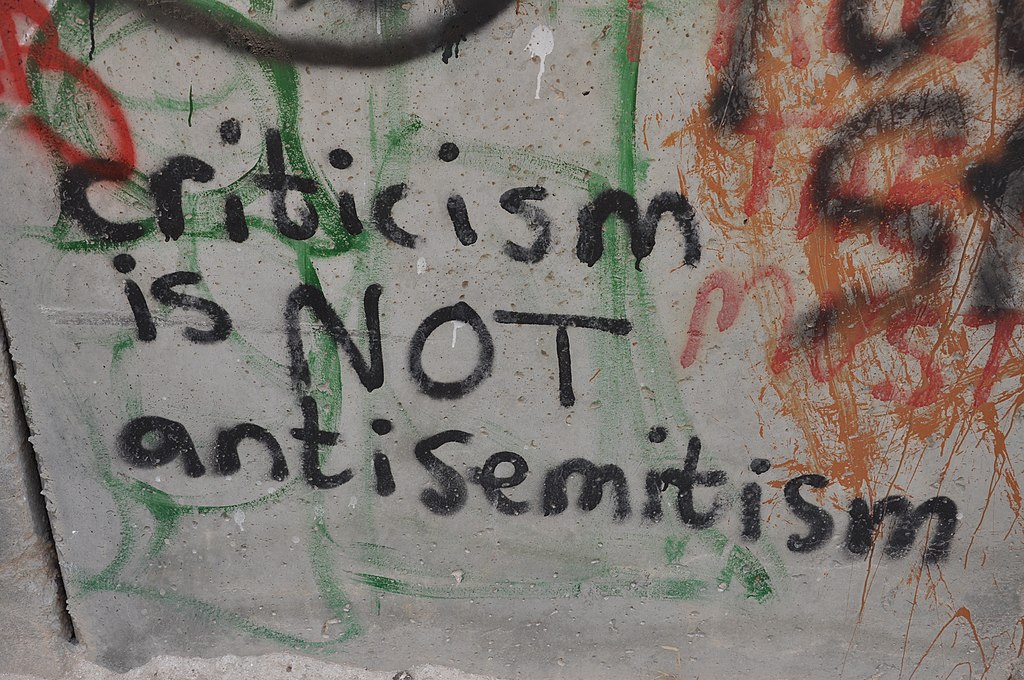
Why the IHRA Working Definition of Antisemitism is causing controversy
Discrimination of any kind has no part in the movement for a just peace for Palestinians. We oppose discrimination and racism against Palestinians and we stand with our Jewish friends in identifying and challenging antisemitism wherever we find it.
We also need to ensure that accusations of antisemitism are not used in a way that shuts down human rights conversations, which is why we do not support the use of the International Holocaust Remembrance Alliance (IHRA) Working Definition of Antisemitism as a tool for public policy.
Existing definitions of antisemitism
Dictionary definitions of antisemitism are consistent, short and precise—such as The hostility toward or discrimination against Jews as a religious, ethnic, or racial group.
The International Holocaust
Remembrance Alliance (IHRA)
The IHRA is an inter-Governmental organisation founded by the Swedish Prime Minister in1988. It focuses on Holocaust education, research and remembrance worldwide. Australia is one of 34 member countries, having joined in 2019.

Context—IHRA definition
The working definition of antisemitism is based on draft developed by the European Monitoring Centre on Racism and Xenophobia in the early 2000’, which was never formally adopted.
This working definition was adopted by members of the IHRA in 2016, following intervention from the Simon Wiesenthal Center.
The Centre, a pro-Israel organisation which has attempted to smear the work of UN bodies in Palestine, boast they “introduced and steered the Working Definition to adoption”.
The definition is increasingly being used as a tool for public policy, with it being adopted by a number of countries including the US State Department, Germany, France, Israel as well as
organisations, local councils and political parties.
A number of bodies have recommended the use of the definition but only with clarification. For example, UK Home Affairs Committee & subsequently the Cambridge University adopted the
definition but with the following clarifications to protect freedom of speech:
“It is not anti-Semitic to criticise the government of Israel, without additional evidence to suggest anti-Semitic intent
It is not anti-Semitic to hold the Israeli government to the same standards as other liberal democracies, or to take a particular interest in the Israeli government’s policies or actions, without
additional evidence to suggest anti-Semitic intent.”
Who has concerns with IHRA definition
Legal experts – including Geoffrey Robertson AO QC
Jewish and Holocaust Academics – including David Feldman, Brian Klug, Antony Lerman.
Kenneth Stern – key drafter of IHRA definition. He states the definition is being used to “restrict academic freedom and punish political speech” Human Rights Groups – including Liberty in the UK.
Jewish organisations – joint statement by 41 groups worldwide in 2018 and Progressive Israel Network in 2021. Joining these statements include: New Israel Fund; J -Street; Jewish Voice for Peace.
122 Palestinian academics and intellectuals in 2020
Concerns about the IHRA definition
- The language is vague, and open to interpretation
- Its wording invites a conflation of the criticism of Israel with antisemitism
- The complexity of language and multiplicity of references to Israel will stifle legitimate criticism of Israel
Definitions will always be contested. What is concerning however is that the definition is used to police speech. The examples of antisemitism which the definition provides have been taken up in a way which enforces unacceptable limits on what can be said.
In both Canada and the UK, funding to Universities is being threatened unless they adopt this particular definition.
This is happening in a broader context where accusations of anti-semitism are being used to stifle legitimate debate and criticism of the policies and actions of Israel.
“… for the past decade, Jewish groups have used the definition as a weapon to say anti-Zionist expressions are inherently anti-Semitic and must be suppressed.”
Kenneth Stern, drafter of Working Definition
Text of the IHRA definition
Antisemitism is a certain perception of Jews, which may be expressed as hatred toward Jews. Rhetorical and physical manifestations of antisemitism are directed toward Jewish or non-Jewish individuals and/or their property, toward Jewish community institutions and religious facilities.
To guide IHRA in its work, the following examples may serve as illustrations:
Manifestations might include the targeting of the state of Israel, conceived as a Jewish collectivity. However, criticism of Israel similar to that leveled against any other country cannot be regarded as antisemitic. Antisemitism frequently charges Jews with conspiring to harm humanity, and it is often used to blame Jews for “why things go wrong.” It is expressed in speech, writing, visual forms and action, and employs sinister stereotypes and negative character traits.
Contemporary examples of antisemitism in public life, the media, schools, the workplace, and in the religious sphere could, taking into account the overall context, include, but are not limited to:
- Calling for, aiding, or justifying the killing or harming of Jews in the name of a radical ideology or an extremist view of religion.
- Making mendacious, dehumanizing, demonizing, or stereotypical allegations about Jews as such or the power of Jews as collective — such as, especially but not exclusively, the myth about a world Jewish conspiracy or of Jews controlling the media, economy, government or other societal institutions.
- Accusing Jews as a people of being responsible for real or imagined wrongdoing committed by a single Jewish person or group, or even for acts committed by non-Jews.
- Denying the fact, scope, mechanisms (e.g. gas chambers) or intentionality of the genocide of the Jewish people at the hands of National Socialist Germany and its supporters and accomplices during World War II (the Holocaust).
- Accusing the Jews as a people, or Israel as a state, of inventing or exaggerating the Holocaust.
- Accusing Jewish citizens of being more loyal to Israel, or to the alleged priorities of Jews worldwide, than to the interests of their own nations.
- Denying the Jewish people their right to self-determination, e.g., by claiming that the existence of a State of Israel is a racist endeavor.
- Applying double standards by requiring of it a behavior not expected or demanded of any other democratic nation.
- Using the symbols and images associated with classic antisemitism (e.g., claims of Jews killing Jesus or blood libel) to characterize Israel or Israelis.
- Drawing comparisons of contemporary Israeli policy to that of the Nazis.
- Holding Jews collectively responsible for actions of the state of Israel.